Lewrick & Company

Business Ecosystem Design · Agentic AI · Growth

AI agents need ecosystems.
From MVP to MVE.

AI agents create value only when they can act across partners: data, payment, logistics, service. That is an ecosystem. Michael Lewrick has written about the minimum viable ecosystem (MVE) since 2018 and wrote the book on business ecosystem design. He helps leadership teams design ecosystems in which companies, partners and AI agents deliver what no single company can.

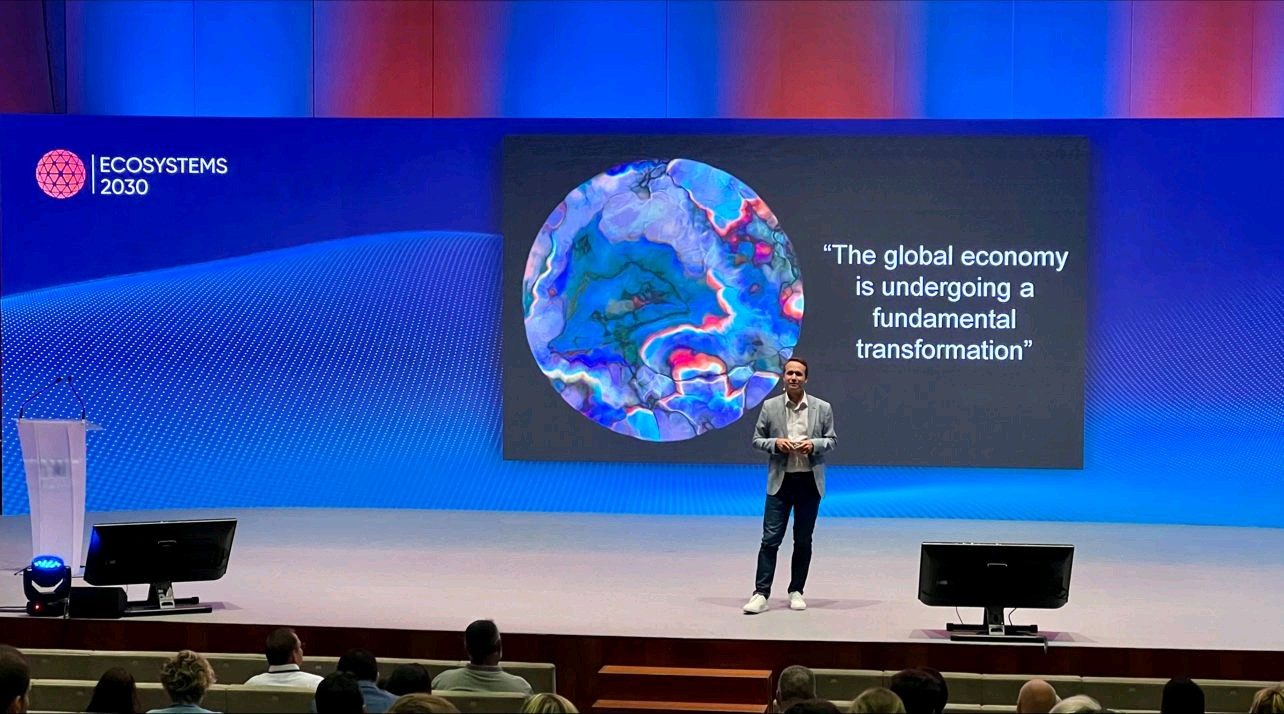
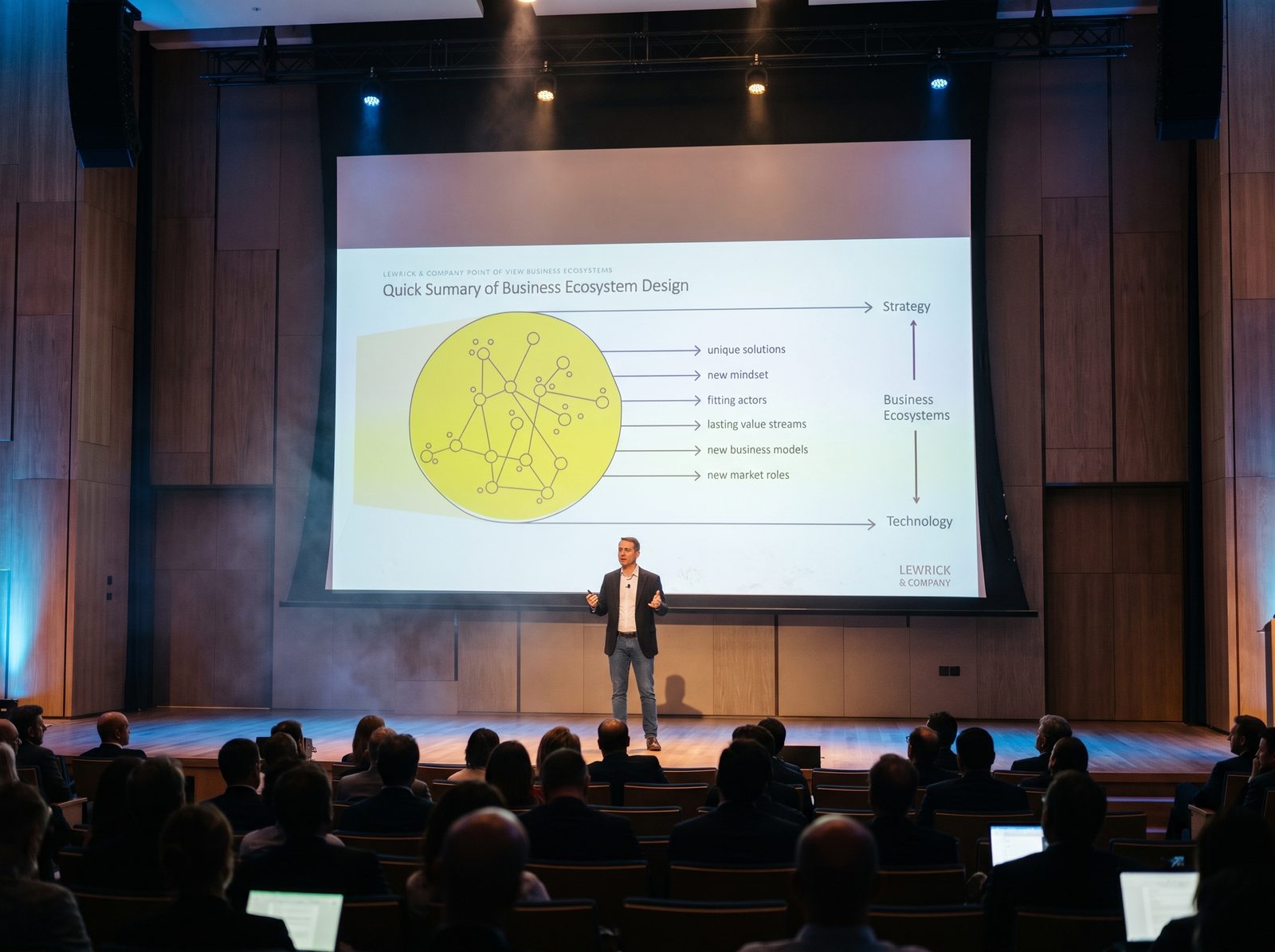
Michael Lewrick on stage in front of a slide titled Quick Summary of Business Ecosystem Design
Keynote · Business ecosystem design: strategy and technology in one system
2018first articles on the minimum viable ecosystem
15+languages the book has been translated into
50+tools and canvases, from strategy to scale
Drucker Schoolbootcamp at the Center for the Future of Organization
E

Why Europe needs to think in ecosystems now

Industry boundaries are dissolving. Value no longer comes from one company’s product but from the system around the customer.

Europe is good at products, pilots and partnerships on paper. China’s leading platforms build ecosystems: one customer relationship, many actors, shared data, payment and logistics, and now AI agents that complete tasks across all of them.

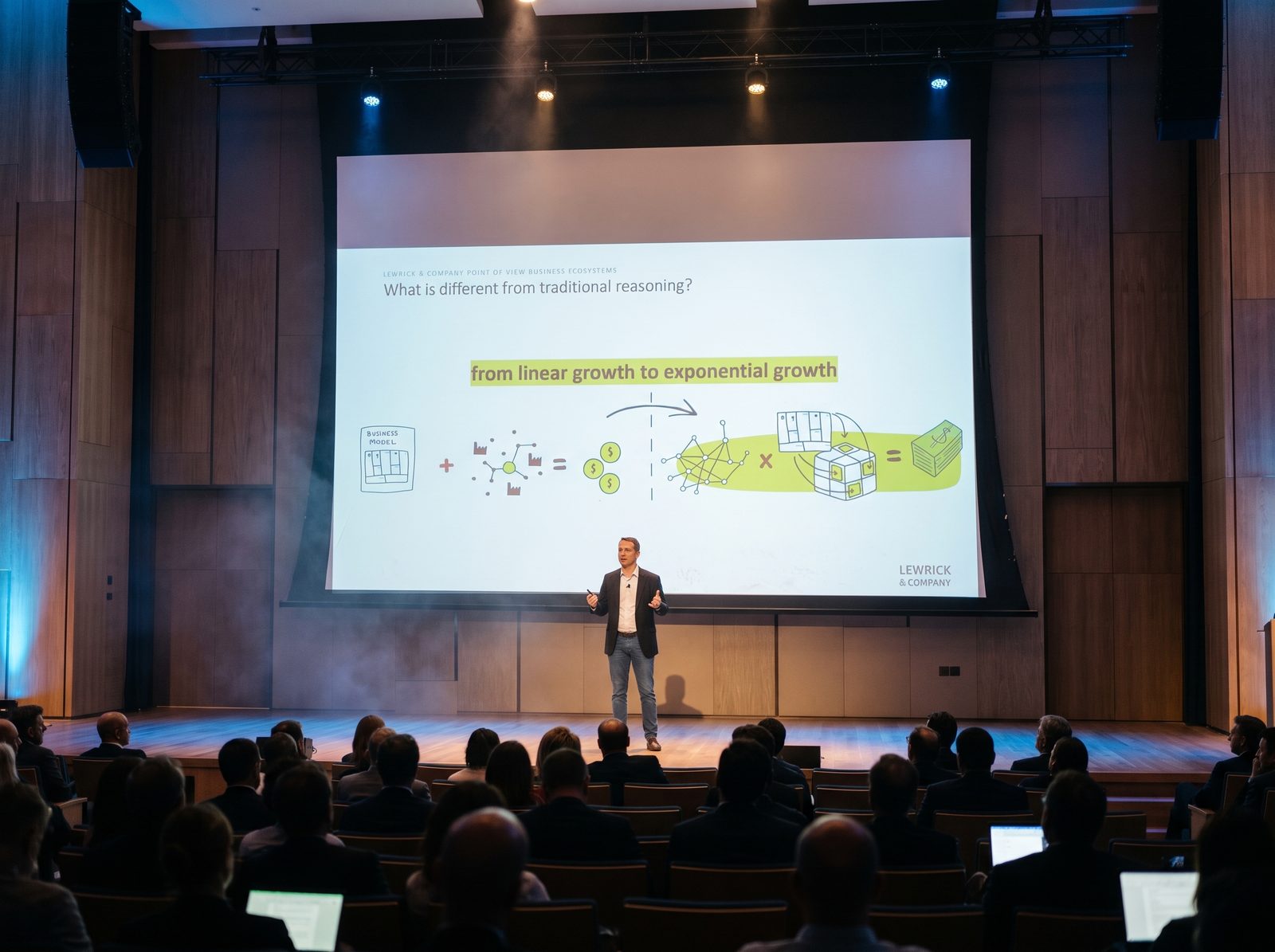
The result is a different kind of growth. Linear growth comes from one business model plus some partners. Exponential growth comes from a network of actors whose business models reinforce each other. With agentic AI the gap widens: an agent can only book, buy or solve a problem if the services behind it are connected.

Agentic AI does not replace ecosystem design. It makes it urgent.

Michael Lewrick on stage presenting from linear growth to exponential growth

Five shifts in thinking

  1. From productsto value propositions delivered by several actors
  2. From value chainsto value streams that benefit every actor
  3. From “Yes, but”to “Yes! … and”, with partners on equal footing
  4. From time spentto tasks completed, increasingly by AI agents
  5. From big plansto a minimum viable ecosystem that proves itself fast
M

From MVP to MVE

Design thinking finds the right problem. Lean start-up proves the product. Business ecosystem design adds the step most companies miss: the fit between the system and its actors.

  1. 1Problem/solution fitDesign thinkingFind the real customer need and a solution that is as elegant as it is simple.
  2. 2Product/market fitLean start-up · MVPValidate the offer with a minimum viable product and fast build–measure–learn cycles.
  3. 3System/actors fitEcosystem design · MVEBring together the actors who deliver the value proposition, each with a clear role and benefit.
  4. 4Ecosystem evolutionGrowth and scaleUse network effects, data and new actors to let the system grow exponentially.

What is a minimum viable ecosystem?

A minimum viable ecosystem (MVE) is the first working version of a business ecosystem in its most efficient form. It has at least one actor for each market role it needs, a value proposition the actors shape together, and value streams from which every actor benefits. Like an MVP, it is built to learn fast, and it grows from there.

Four design loops to an MVE

Virtuous design loopDefine the value proposition, identify the actors and their capabilities, and test the system in role plays.
Validation loopCheck with real actors whether roles, value streams and business models hold.
Realization loopBuild the MVE, agree on governance, data and technology, and launch with the first customers.
Experiment loopMeasure, learn and redesign: add actors, adjust value streams, scale what works.

Source: Michael Lewrick, Design Thinking for Business Growth (Wiley) and changement! 08/2021.

C

What Europe can learn from China’s commerce ecosystems

Over the past 20 years, Michael Lewrick’s frameworks have strongly influenced Chinese companies (including Tencent, Alibaba, Ant Group and Ping An): first with design thinking, later with business ecosystem design and the MVE. They gave these companies the frameworks to build scalable business models. Today the leading platforms are adding AI agents to their ecosystems. Three examples from Michael Lewrick’s keynote The Future of Commerce (Zurich, October 2026):

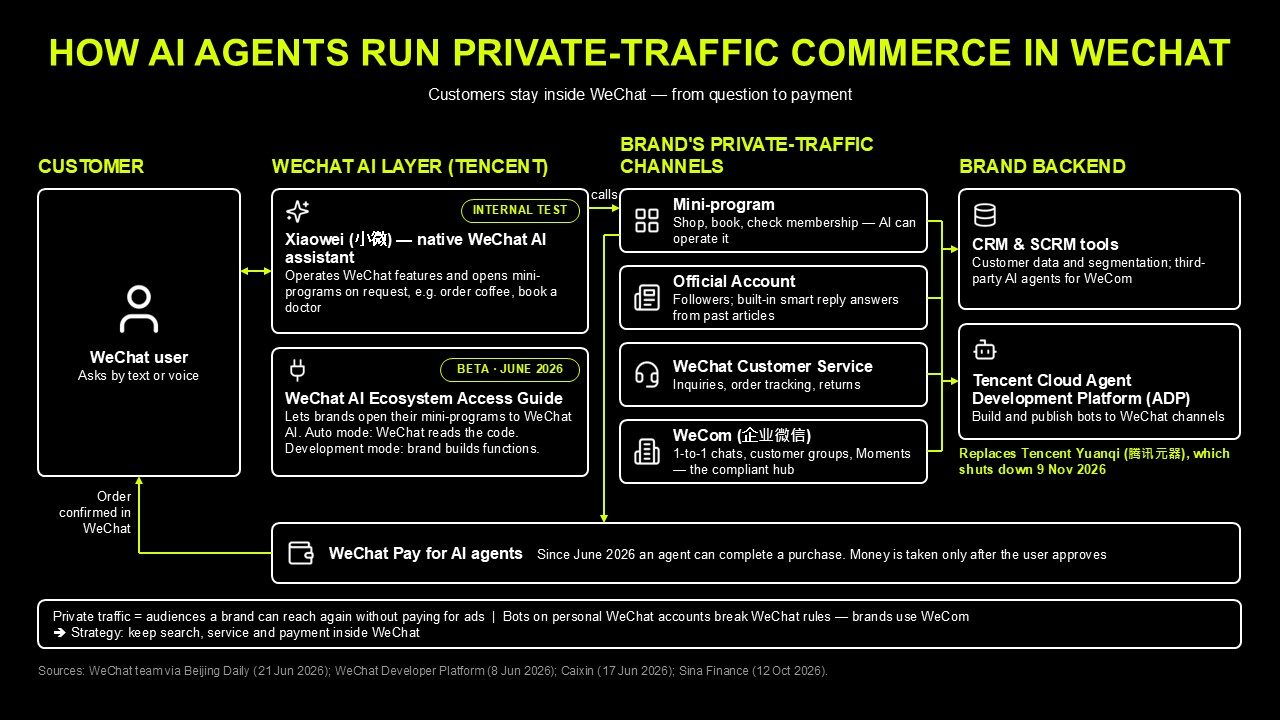
Diagram: how AI agents run private-traffic commerce in WeChat, from customer through the WeChat AI layer and brand channels to the brand backend

Tencent · WeChat

Commerce inside the conversation

More than 1.4 billion monthly users message, pay, book and shop without leaving WeChat. Since 2026 an AI assistant opens brands’ mini-programs on the user’s behalf, and since June 2026 agents can pay with WeChat Pay once the user approves. Search, service, sale and payment happen in one conversation.

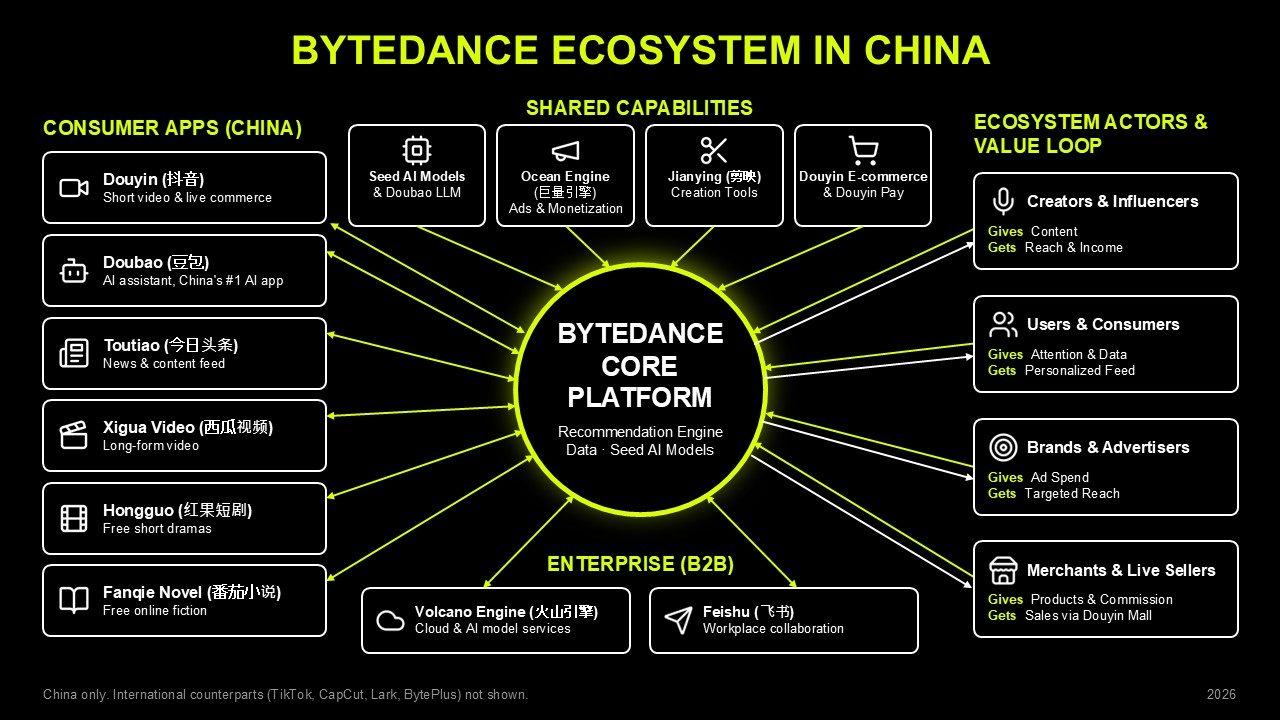
Diagram: the ByteDance ecosystem in China with consumer apps, shared capabilities, enterprise services and the value loop between creators, users, brands and merchants

ByteDance

One engine, many apps, one value loop

A recommendation engine powers Douyin, Doubao, Toutiao and more. Creators bring content, users attention, brands ad spend, merchants products. Every interaction trains the engine, and the loop gets stronger with each turn.

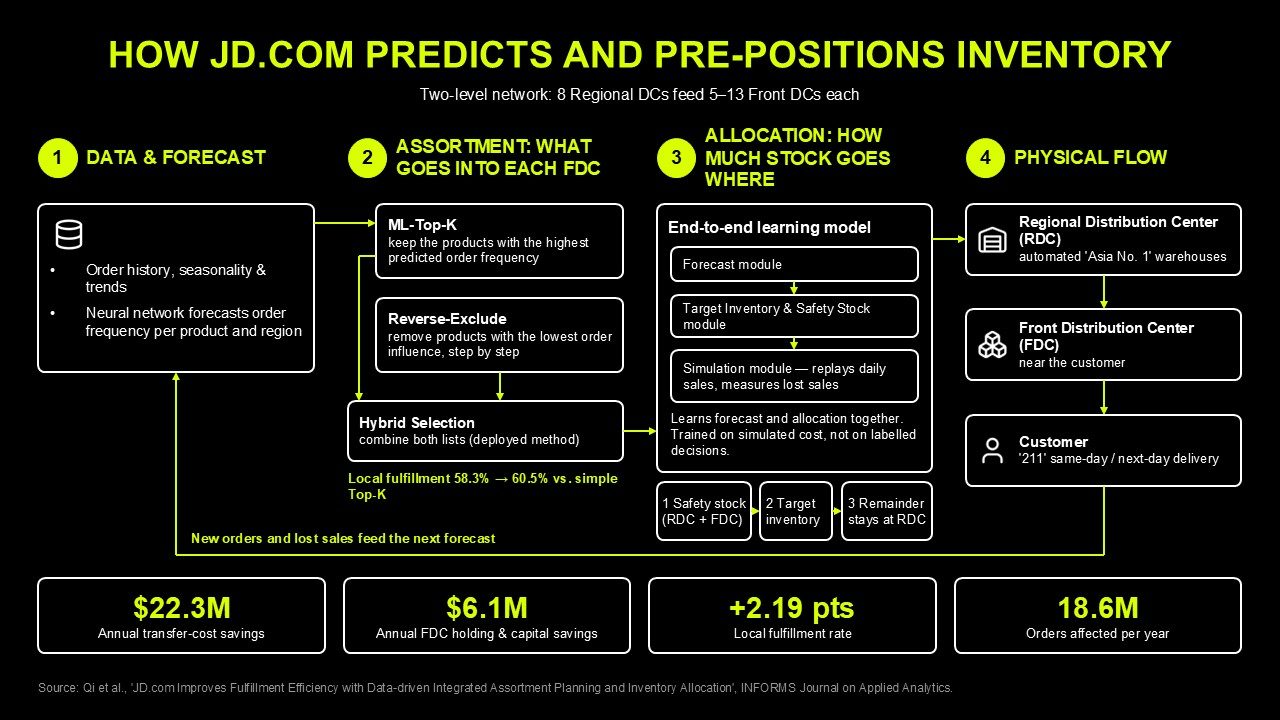
Diagram: how JD.com predicts and pre-positions inventory, from data and forecast to assortment, allocation and physical flow

JD.com

The product is there before you order

AI forecasts demand per product and region and moves stock to front distribution centres near customers. A published study reports USD 22.3 million in annual transfer-cost savings. With Joybuy and its offer for MediaMarkt and Saturn, JD brings this model to Europe.

The rules of the game are changing

  • FromTo
  • Time spentTasks completed
  • Keeping users on the platformGetting the job done
  • Selling adsEarning on what the agent delivers

When agents shop for consumers, the winners are the brands and ecosystems that agents can find, understand, trust and transact with.

Sources: WeChat team via Beijing Daily (21 Jun 2026); WeChat Developer Platform; Qi et al., INFORMS Journal on Applied Analytics; Lewrick & Company (2026).

?

Ecosystem questions

How might we …? Ten ecosystem questions for ten industries

Every ecosystem starts with a good question. Use these as a starting point for your leadership team.

1 of 10
  • 01Banking

    How might we become the trusted hub for a customer’s home purchase, from search and financing to moving in, together with real estate, insurance and utilities partners?

    Actors: bank, property platforms, notaries, insurers, utilities, moversAgent role: an agent that compares offers and books the next step

  • 02Insurance

    How might we move from paying claims to preventing them, with partners who keep homes, cars and people healthy?

    Actors: insurer, smart-home providers, garages, health servicesAgent role: an agent that spots risks and arranges the fix

  • 03Healthcare and life sciences

    How might we connect patients, physicians, pharmacies and payers so that a therapy works better in everyday life, not only in the study?

    Actors: pharma, clinics, pharmacies, insurers, digital health appsAgent role: an agent that supports adherence and flags side effects

  • 04Retail and e-commerce

    How might we make our products findable, understandable and buyable for AI agents that shop on behalf of our customers?

    Actors: retailer, brands, logistics, payment, marketplacesAgent role: shopping agents that compare, order and pay

  • 05Mobility

    How might we offer door-to-door journeys across rail, bus, car sharing and bikes with one booking and one bill?

    Actors: rail, local transport, sharing providers, parking, citiesAgent role: an agent that plans, books and rebooks in real time

  • 06Energy and utilities

    How might we help households and SMEs produce, store and share energy as part of a local energy community?

    Actors: utility, installers, storage providers, grid operators, municipalitiesAgent role: an agent that trades and balances energy automatically

  • 07Manufacturing

    How might we sell outcomes such as uptime or output instead of machines, together with service, data and financing partners?

    Actors: manufacturer, service partners, sensor and data providers, leasingAgent role: an agent that predicts maintenance and orders spare parts

  • 08Tourism and hospitality

    How might we turn a region into one seamless guest experience, from arrival to the last evening, across hotels, transport and activities?

    Actors: hotels, tourism boards, transport, restaurants, event venuesAgent role: a concierge agent that books across all providers

  • 09Public sector

    How might we let citizens and companies complete a life event, such as founding a company, in one step instead of ten offices?

    Actors: authorities, registers, banks, tax advisers, chambers of commerceAgent role: an agent that fills in, submits and tracks applications

  • 10Telecommunications

    How might we use our connectivity and customer access to orchestrate a smart-home or SME ecosystem instead of selling data plans?

    Actors: telco, device makers, security and IT service providers, installersAgent role: an agent that sets up, secures and supports the customer’s devices
T

The business ecosystem design toolkit

More than 50 tools and canvases from the book guide teams from strategy to scale. Four canvases form the backbone:

Ecosystem strategy canvasDesign principles, initiatives and cooperation matrices, topic areas, PESTLE, play-and-win configuration
Ecosystem design canvasValue proposition for the MVE, actors and roles, role play, ecosystem maps, value streams, revenue models
Growth and scale canvasCustomers and community, scalable processes and data, touch points, network effects, ecosystem culture
Ecosystem reflection canvasWhere the system stands, what to change and which tools to use next
Value proposition statement for the MVEIdentification and description of actorsRole play: actors in the systemEcosystem mapsDefinition of value streamsExploration of revenue modelsTransfer of MVPs to MVEEcosystem configuration gridNetwork effects and ecosystem cultureTemplates and resources →
F

How we work with you

Keynote45–90 minutes
AI agents need ecosystems

Why business ecosystems decide the next decade of growth, what China gets right, and what it means for your industry.

Masterclass1–2 days
From MVP to MVE

Your leadership team works on a real ecosystem question with the canvases from the book and leaves with a first MVE design.

Bootcamp and capability building2 days to 8 weeks
Ecosystem design as a skill

For teams who will design and run ecosystems: the bootcamp with the Drucker School’s Center for the Future of Organization or in-house programmes for corporate teams.

AdvisoryProject
Ecosystem strategy and MVE

Strategy, actor mapping, value streams, governance and data, and the design of agentic services across partners.

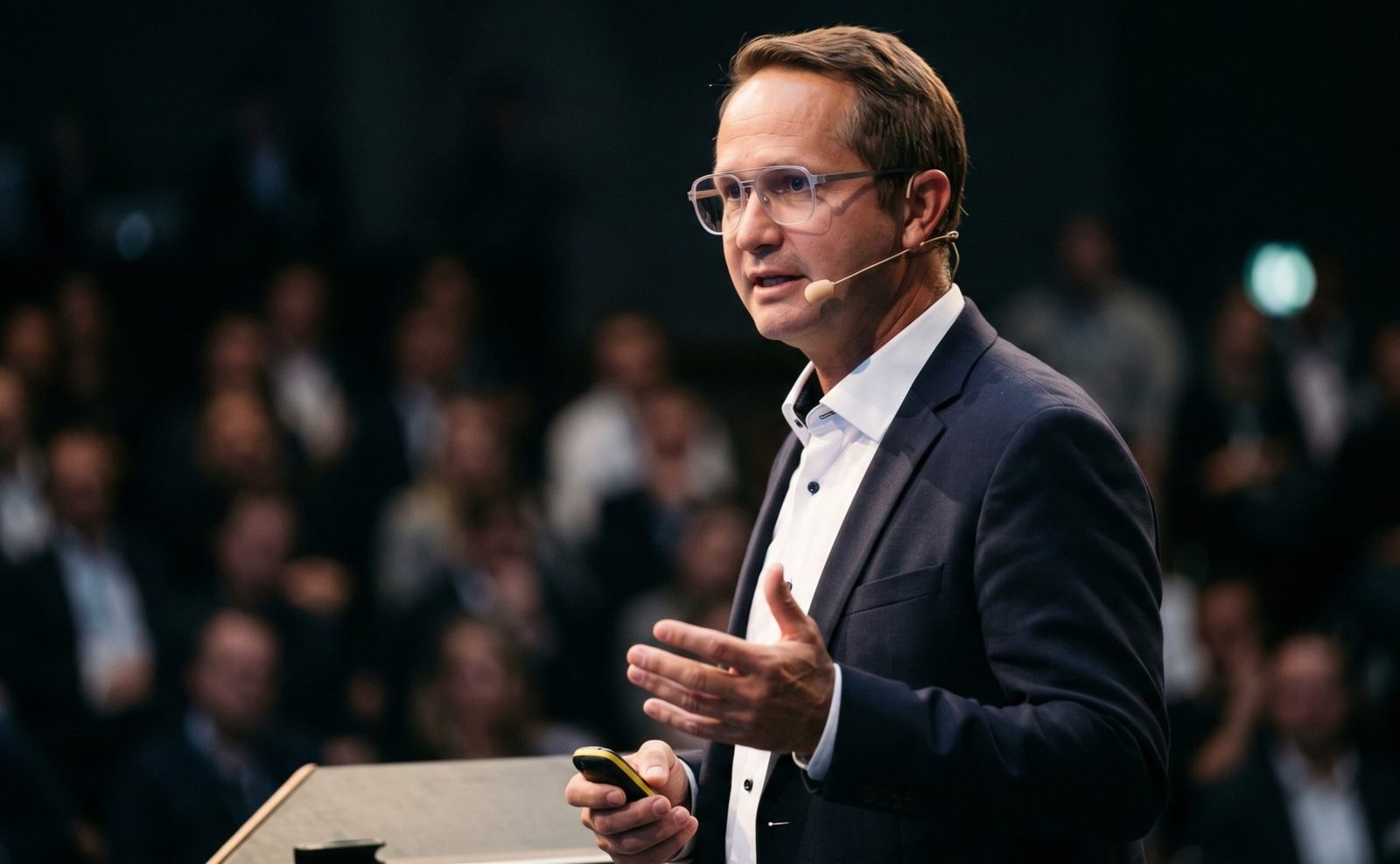
Michael Lewrick speaking on stage with a headset microphone
Keynote by Michael Lewrick

Expert at the Drucker School

The Business Ecosystem Design Bootcamp at the Center for the Future of Organization

At the Center for the Future of Organization (CFFO) of the Drucker School of Management, Claremont Graduate University, Michael Lewrick leads the Business Ecosystem Design Bootcamp, based on his book Design Thinking for Business Growth.

  • Two to five days, on site or online
  • For entrepreneurs, C-level, strategy and innovation executives
  • Ten design principles for business ecosystems
  • Four design lenses: problem, MVP, MVE, scale
  • Hands-on work on your own company context
  • Impact on IT, customer interaction, business models and governance

“The only thing we know about the future is that it will be different.” Peter F. Drucker

The bootcamp at the CFFO →
L

Thought leadership since 2018

Michael Lewrick introduced the minimum viable ecosystem to practitioners in 2018 and has shaped business ecosystem design as a discipline that expands design thinking.

His book hits the zeitgeist and is the best definition of business ecosystem design I have read so far.
Larry LeiferProfessor of Mechanical Engineering Design, Stanford University
Many people have talked about the design of business ecosystems. This book depicts impressively how to approach it.
Ash MauryaAuthor and inventor of the Lean Canvas
The capability of designing business ecosystems will become one of the key skills for companies in the next decade.
Patrick van der PijlCEO Business Model Inc., in the foreword
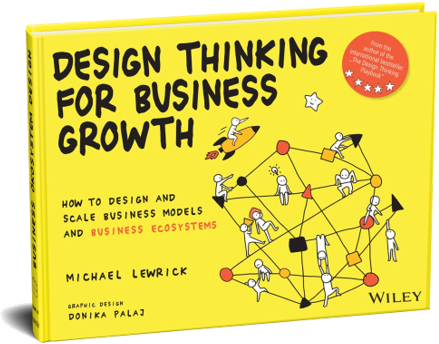
Cover of the English · Wiley edition of the book on business ecosystem design by Michael Lewrick

The book

Design Thinking for Business Growth

How to Design and Scale Business Models and Business Ecosystems

Michael Lewrick · illustrations by Donika Palaj · Wiley · ISBN 978-1-119-81515-0

The practical guide to business ecosystem design: the problem-to-growth-and-scale framework, design lenses, the MVE, more than 50 tools, and international examples from Tencent and Ant to Ping An, DBS and Amazon.

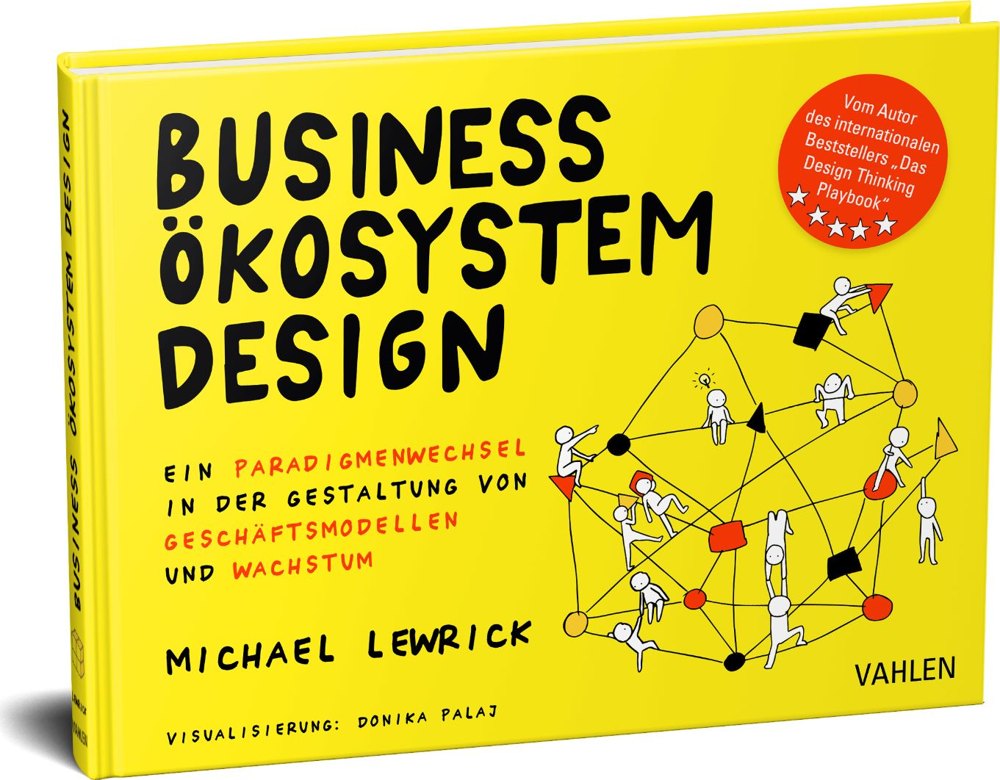
Cover of the German · Vahlen edition of the book on business ecosystem design by Michael Lewrick
German · Vahlen
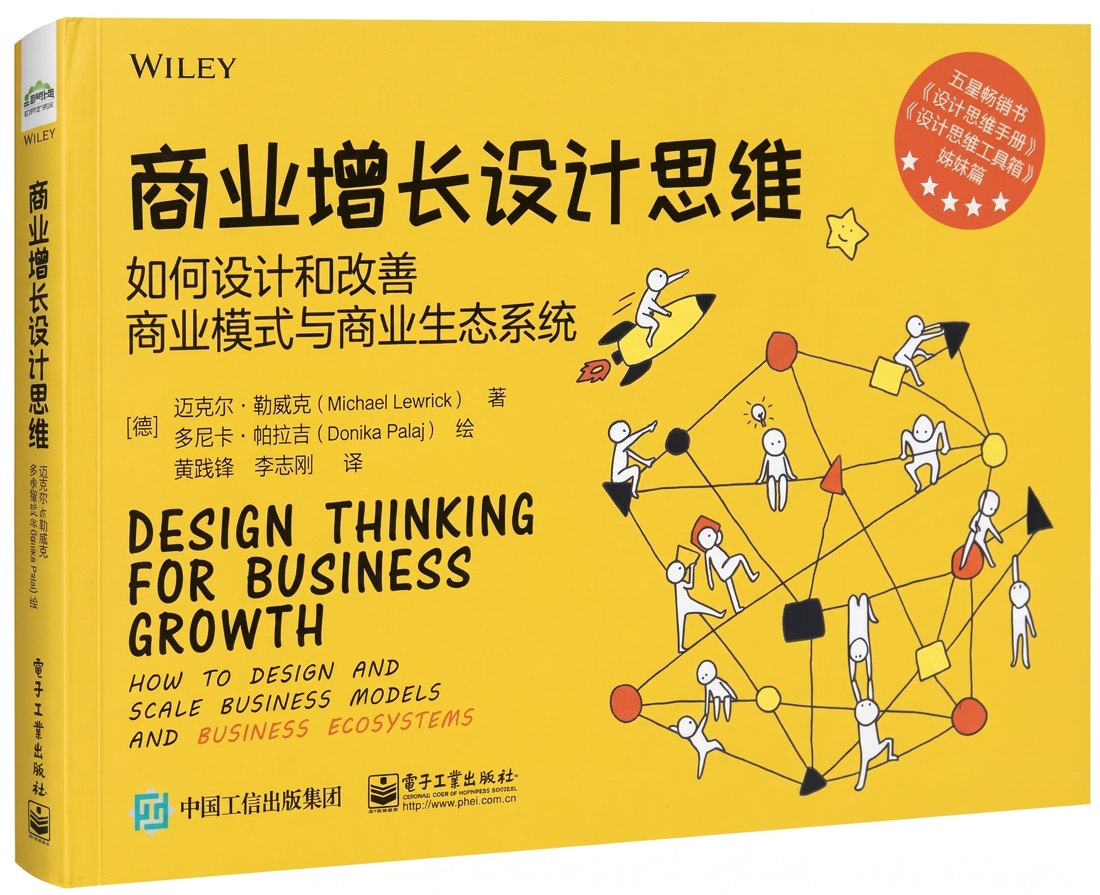
Cover of the Chinese · PHEI edition of the book on business ecosystem design by Michael Lewrick
Chinese · PHEI
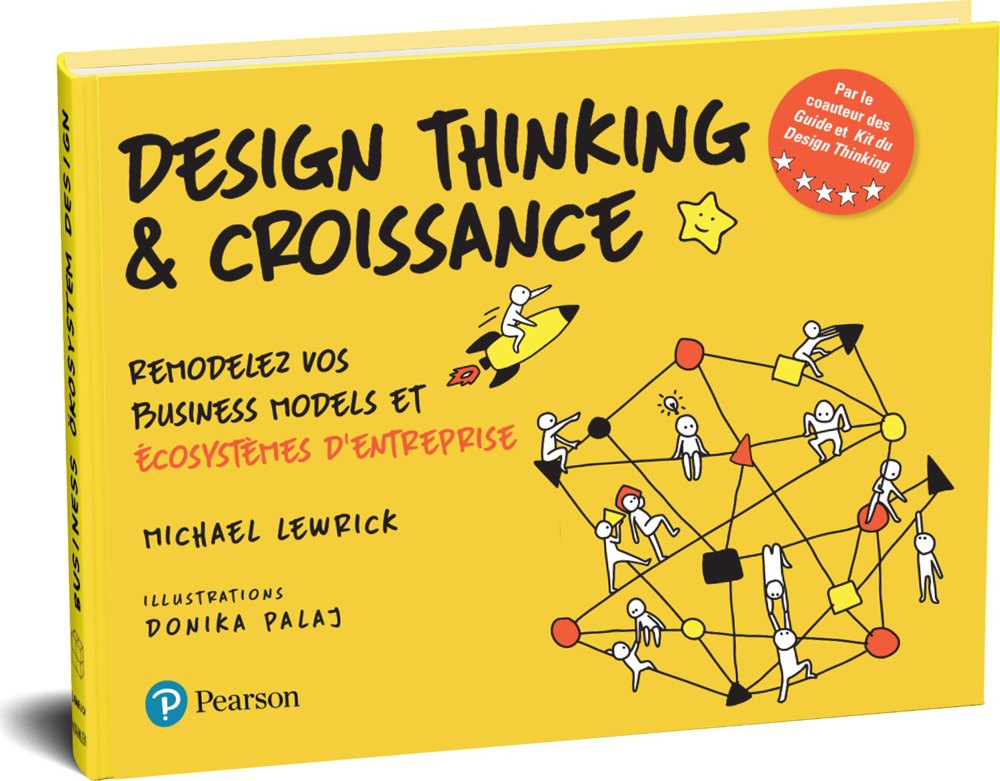
Cover of the French · Pearson edition of the book on business ecosystem design by Michael Lewrick
French · Pearson
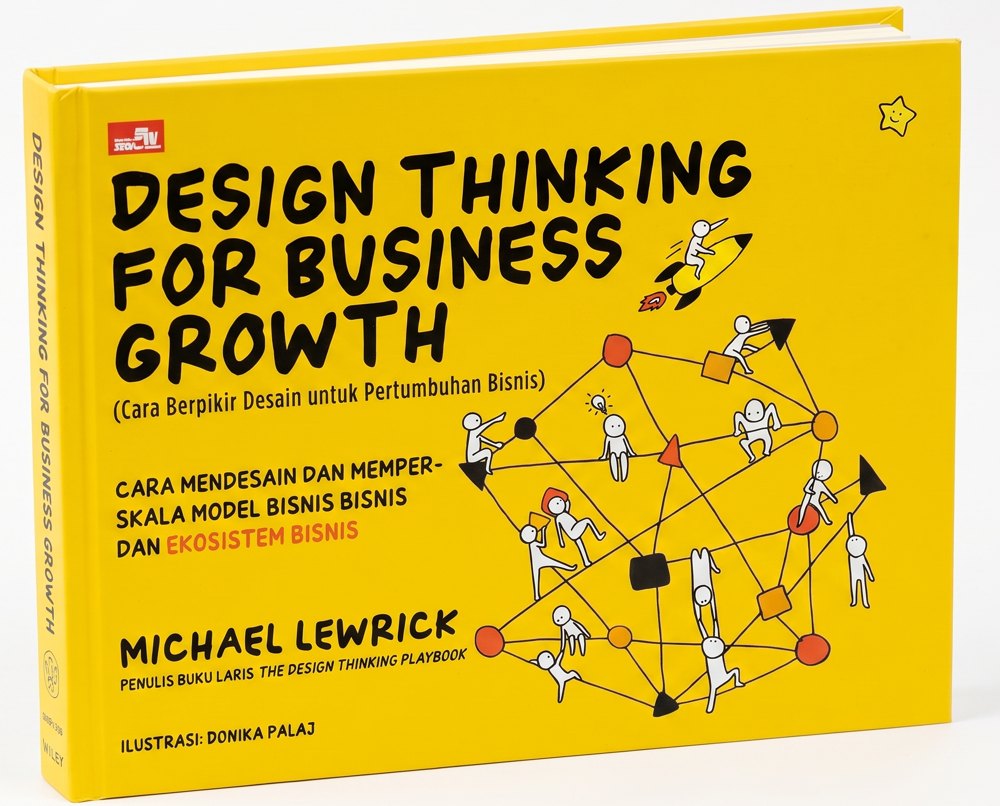
Cover of the Indonesian edition of the book on business ecosystem design by Michael Lewrick
Indonesian

Translated into more than 15 languages, including German, English, Chinese, Japanese, French and Indonesian.

Buy the book on Amazon →

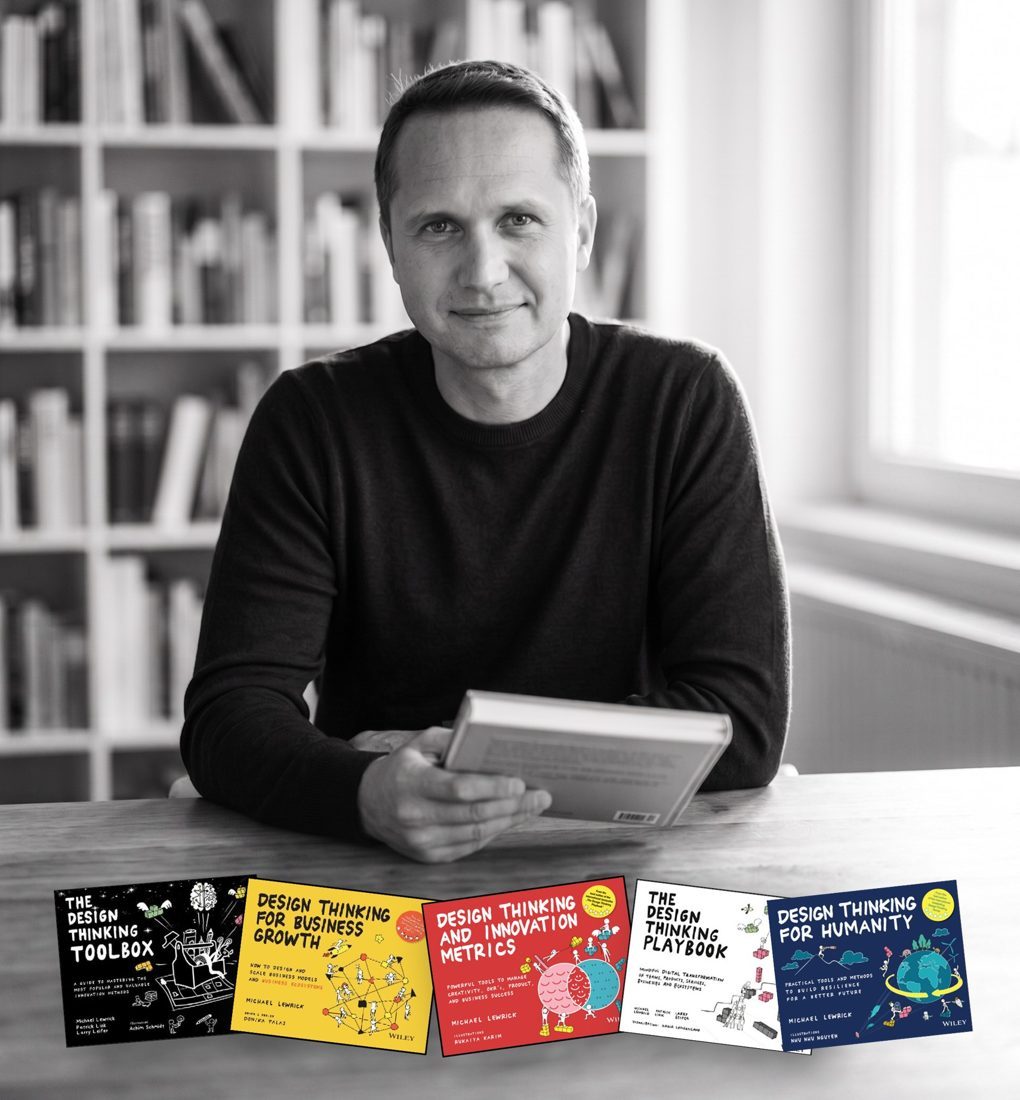
Michael Lewrick at a table with his five books on design thinking

Michael Lewrick

Michael Lewrick is a bestselling author, keynote speaker and advisor on innovation, AI and business ecosystems. His Wiley design thinking series has reached more than three million readers in over 25 languages. As former Chief Innovation Officer at Swisscom, he brought ecosystem thinking into practice long before the term was common. Today he advises executive teams through Lewrick & Company in Vaduz, Liechtenstein.

More about Michael →
Q

Frequently asked questions

What is business ecosystem design?

Business ecosystem design is the deliberate design of a network of companies and other actors that together deliver a value proposition no single company could offer alone. It expands design thinking from the customer and the product to the whole system: actors, roles, value streams, business models and governance.

What is a minimum viable ecosystem (MVE)?

A minimum viable ecosystem is the first working version of a business ecosystem in its most efficient form. It includes at least one actor for each necessary market role, a jointly shaped value proposition and value streams that benefit every actor. Like a minimum viable product, it is designed to learn fast and grow step by step.

What is the difference between an MVP and an MVE?

An MVP tests whether a product solves a customer problem (product/market fit). An MVE tests whether the right actors can deliver a value proposition together and all benefit from it (system/actors fit). Many ecosystem initiatives fail because they skip this second fit.

Why do AI agents need ecosystems?

An AI agent creates value by completing tasks such as booking, buying or solving a problem. To do so, it must act across services from different providers: data, payment, logistics and service. Only an ecosystem connects these services. That is why Chinese platforms such as WeChat combine ecosystems and agents, and why ecosystem design becomes urgent with agentic AI.

What can European companies learn from China?

Chinese platforms build vertical use cases into existing ecosystems, scale them fast and measure success in cost and revenue. European companies can learn to design around one customer relationship, open their services to partners and agents, and start with a minimum viable ecosystem instead of a large plan.

Who is Michael Lewrick?

Dr. Michael Lewrick is the author of Design Thinking for Business Growth (Wiley), Business Ökosystem Design (Vahlen) and the bestselling Wiley design thinking series. He has written about the minimum viable ecosystem since 2018, led the business ecosystem design bootcamp at the Drucker School’s Center for the Future of Organization and advises companies through Lewrick & Company in Vaduz, Liechtenstein.

In which languages are keynotes and workshops held?

In English or German, on site or online.

Contact

Design your ecosystem

Tell us your industry, your ecosystem question and the format you have in mind. We reply within two working days.

info@lewrick.chLinkedIn