Lewrick & Company

Design Thinking for Humanity · Resilience · Regenerative innovation

Human-centred is no longer enough. Design for humanity.

The challenges of our time are wicked, connected and accelerating. Solving for the user alone optimises one person and leaves the system in the dark. Design Thinking for Humanity combines five lenses, Futures, Design, Ecological, Systems and Exponential Thinking, so that organisations, society and the planet win together.

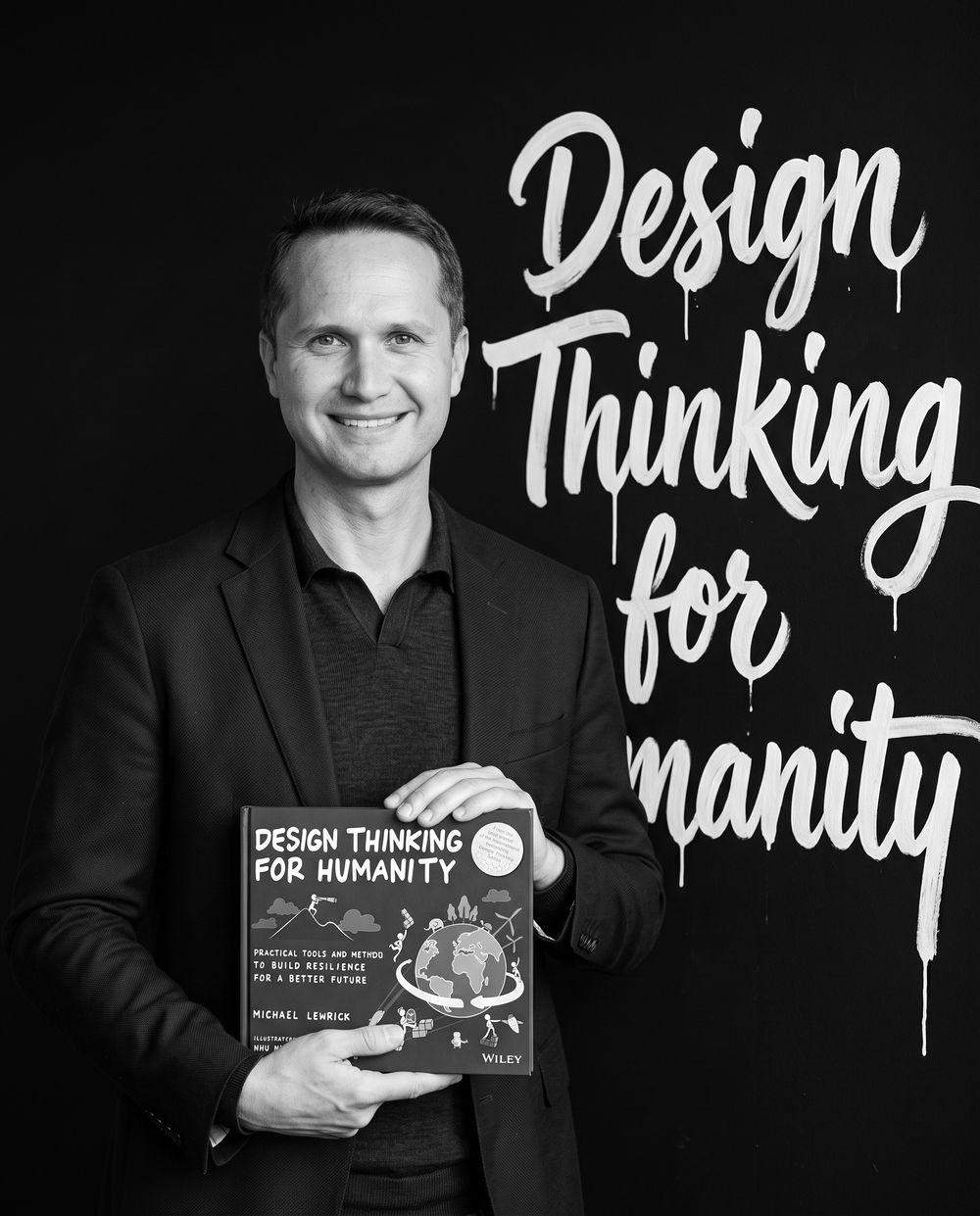
Michael Lewrick holding the book Design Thinking for Humanity in front of a lettering wall with the book title
New book · Design Thinking for Humanity, Wiley 2026
5 lensesFutures, Design, Ecological, Systems and Exponential Thinking
45+ toolscanvases and methods, from horizon scanning to the MTP
1 caseThe Living Soil Mandate, followed from vision to global scale
Win-Win-Winfor the organisation, society and the planet
F

From spotlight to floodlight.

Classic human-centred design puts the user in a spotlight. Everything else stays in the dark: the community, nature, future generations, the partners and the AI that shape the outcome.

We solve for the health of the system, not just for user friction.

Design Thinking for Humanity turns the ecosystem from a passive backdrop into a stakeholder. The customer is no longer only the person who pays or clicks, but the web of relationships between people, nature and technology.

  • Deepen the human-planet relationshipHuman well-being is inseparable from planetary health.
  • Strengthen your futures imaginationMove beyond prediction and chart bold pathways to a resilient future.
  • Integrate ecological thinkingMake ecological integrity a design constraint, regenerative by design.
Move the spotlight
The user
Future generations
Community
Biodiversity
Partners & ecosystem
Soil, water & climate
AI agents & data
Society & trust
Spotlight · human-centred design
R

Robust is not enough. Resilient is not enough. Bounce forward.

A resilient system bounces back, often to the same vulnerability. An exponentializing system uses the shock as fuel: it learns faster, adapts and comes out stronger.

time value for people, planet, business Change current situation Decay · lose-lose Robust Resilient Exponentializingwin-win-win
  1. 01Embrace radical diversityBiodiversity in ecosystems, cognitive diversity in teams.
  2. 02Build intelligent redundancyEfficiency is brittle. Redundancy is insurance.
  3. 03Nurture mindful connectivityConnected, but with firewalls against cascading shocks.
  4. 04Design for equityA system that benefits only a few is inherently unstable.
  5. 05Embed adaptive learningFeedback loops that sense, learn and transform in real time.
5

Five lenses. One way of seeing the whole.

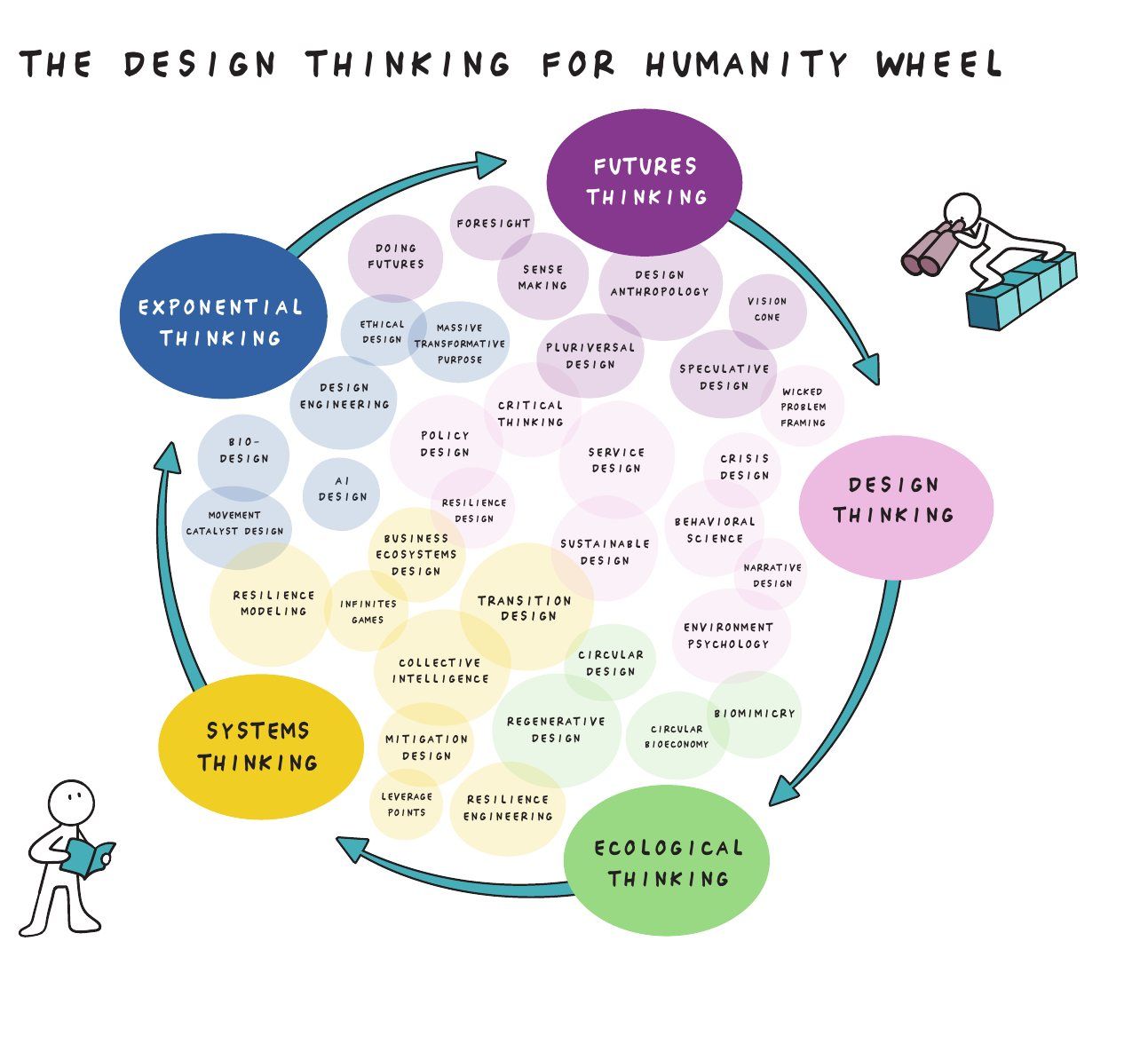
No single method can bring a system back into balance. The five lenses work together around one centre: human- and life-centred values. Select a lens.

FUTURESTHINKING DESIGNTHINKING ECOLOGICALTHINKING SYSTEMSTHINKING EXPONENTIALTHINKING Futures ThinkingDesign ThinkingEcological ThinkingSystems ThinkingExponential Thinking Human- &life-centredvalues
Illustration of the Design Thinking for Humanity Wheel with the five lenses and concepts such as foresight, biomimicry, leverage points and massive transformative purpose
The Design Thinking for Humanity Wheel. Illustration: Nhu Nhu Nguyen, from the book.

The wheel

Forty concepts, one integrated practice.

Between the lenses sit the concepts that leadership teams increasingly need: from foresight and speculative design to biomimicry, from leverage points to the massive transformative purpose. The book connects them in one process, so teams no longer have to choose between imagination, empathy, ecology, systems and scale.

ForesightSpeculative designSense making Service designBehavioural scienceNarrative design BiomimicryRegenerative designCircular bioeconomy Leverage pointsTransition designBusiness ecosystem designInfinite games AI designMassive transformative purposeMovement catalyst design
4

Four futures we are designing, right now.

Each future is the sum of today’s decisions. The book closes with four scenarios and one question for every leader: which of these will you actively work to create?

Scenario 1

Fragmented Realities

A world of isolated pockets. Scarcity drives conflict, foresight shrinks to survival, ecological thinking gives way to the fight for resources.

What price are we paying for designing a world where the scarcity we feared became the reality we built?

Scenario 2

Algorithmic Efficiencies

Pervasive AI manages every facet of life. Unprecedented order, at the cost of autonomy, critical thinking and the ability to see truly novel disruption.

What moral contract did we break when perfect efficiency became our ultimate dictator?
The future to build

Scenario 3

Collective Flourishing

Humanity sees itself as part of nature. Distributed, resilient networks, collective intelligence and ethical AI accelerate regeneration and solidarity.

What choices must we embrace so that technology serves not the market, but the collective soul?

Scenario 4

Technocratic Ascent

Unwavering belief in technology. Brilliant breakthroughs and rapid growth, but stratified access, siloed innovation and widening divides.

How do we rationalise a world where innovation became a runaway engine of division?

These four futures are not prophecies. They are blueprints.

L

One challenge through all five lenses: the Living Soil Mandate.

The book follows one speculative design challenge from vision to global scale: a new economic and agricultural model that makes the regeneration of the world’s topsoil the primary measure of agricultural success by 2050.

  1. Setting the directionWeak signals, four agricultural futures from “Regenerative Abundance” to “The Great Dust Bowl”, one preferable future.Horizon scanning · 2x2 scenarios · creative mash-up
  2. The Carbon HarvestJavier, a pragmatic family farmer, becomes the future persona. A wicked problem is framed, a platform ideated.Future persona · wicked problem framing · ethical consequences scanner
  3. Designing for lifeThe solution is checked against planetary boundaries and made regenerative, not just less harmful.LCA simplified · doughnut economics model
  4. The ecosystemFeedback loops are mapped, trust emerges as the key leverage point, a win-win-win ecosystem is designed.Causal loops · leverage points · ecosystem canvas
  5. Global scaleA massive transformative purpose, AI as a planetary nervous system and an ethics compass for scaling responsibly.MTP · 6 Ds · exponential ethics compass

Integrated in the Resilience Blueprint

The Resilience Blueprint: Carbon Harvest

All five lenses, one actionable strategy

Massive transformative purpose

The Living Soil Mandate. Make the regeneration of the world’s topsoil the primary measure of agricultural success by 2050.

Preferable future

Regenerative Abundance. Agriculture as the engine of planetary regeneration. The standard shifts from “bushels per acre” to “profit and resilience per acre”.

Win-win-win value proposition

PeopleFarmers gain diversified, stable revenue from regeneration credits and yield insurance, and regain agency.
PlanetLiving soil stores carbon and water and restores biodiversity.
SocietyResilient, local and nutritious food systems.

Key interventions

Carbon Harvest platform to verify data and trade credits · Safe Harbor contract with floor price and yield insurance to bridge the valley of death · Digital twin linking soil data with weather models for hyper-local forecasts.

M

New mindset. New paradigm. Better solutions.

Six leadership commitments from the book. They turn the five lenses into a culture.

Lead with visionInspire · Empower · TransformA culture of courage, empathy and long-term vision that puts people and the planet first.
Design sustainable offeringsReimagine · Reduce · RestoreEmpathy beyond the user, including non-human stakeholders. Sustainable becomes the standard.
Build thriving ecosystemsConnect · Collaborate · CreateMulti-stakeholder partnerships in which value flows fairly to all participants.
Empower individualsEngage · Educate · EnableShared responsibility and collective action of empowered people.
Future-proof your businessAdapt · Innovate · ThriveCircular and regenerative business models, exponential technologies with ethical guardrails.
Drive regenerative impactRestore · Replenish · RevitalizeBeyond “do no harm” to verifiable, net-positive impact on the biosphere.
31

31 years of negotiation. What we need now is implementation.

From the first climate conference in Berlin to Antalya, the goals have been set. Türkiye calls COP31 the “COP of implementation”. The open question is no longer what, but how.

  1. 1995COP1 BerlinThe first climate conference. The Berlin Mandate starts the negotiation of binding targets.
  2. 1997COP3 KyotoThe Kyoto Protocol sets the first binding emission targets for industrialised countries.
  3. 2015COP21 ParisThe Paris Agreement: well below 2 °C, pursuing 1.5 °C.
  4. 2023COP28 DubaiThe first global stocktake: off track. Call to transition away from fossil fuels.
  5. 2025COP30 BelémAdaptation moves centre stage. Adaptation finance is to triple by 2035.
  6. 2026COP31 Antalya9 to 20 November. The COP of implementation.

Implementation.

Implementation is a design challenge. It needs all five lenses at once.

  • FuturesA shared preferable future, not just a target number.
  • DesignSolutions that people and communities actually adopt.
  • EcologicalRegenerative and nature-inspired, not just less harmful.
  • SystemsLeverage points and coalitions instead of isolated projects.
  • ExponentialScale with technology and ethical intent.
P

Keynotes, workshops and capability building.

From one inspiring hour on stage to a programme that builds the capability inside your organisation: end to end across all five lenses, or as a deep dive into one.

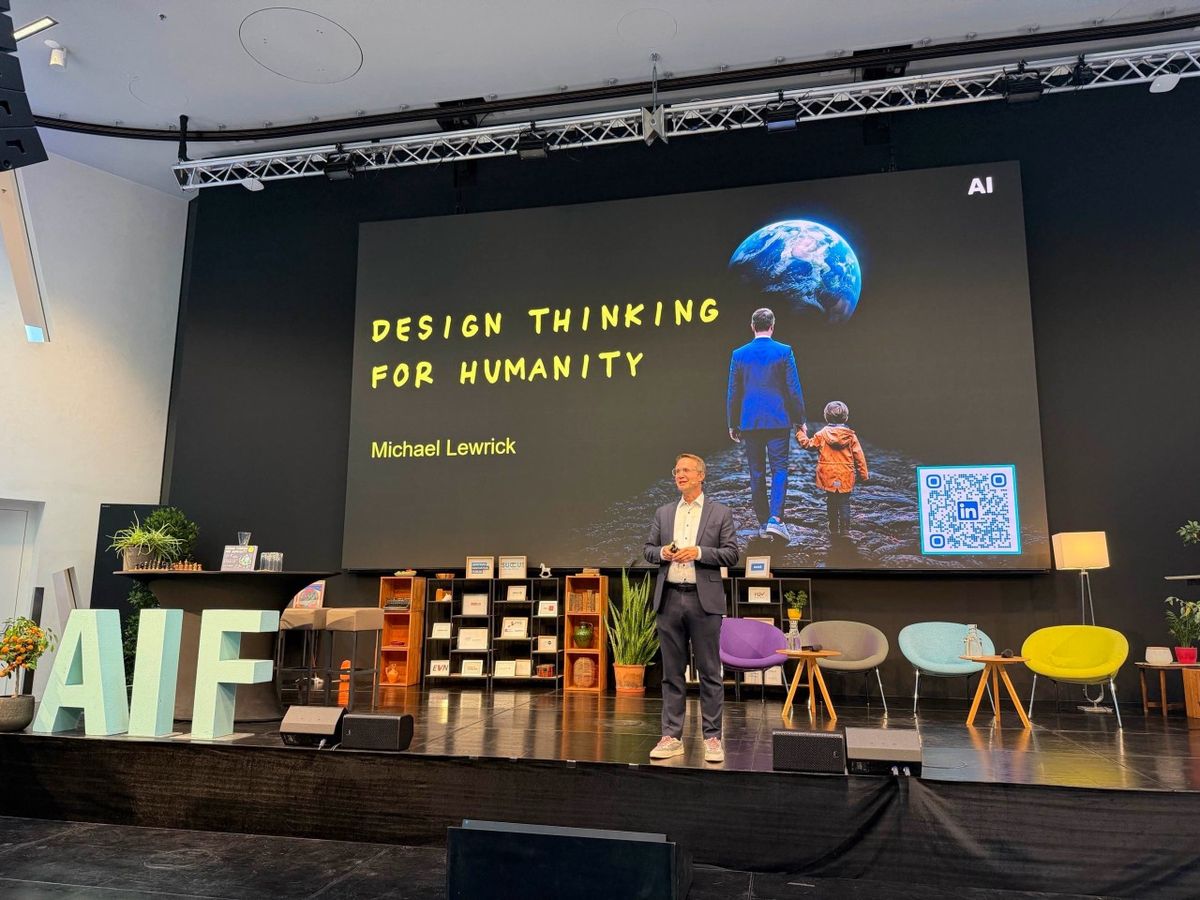
Michael Lewrick on stage in front of a slide titled Design Thinking for Humanity
Keynote · Design Thinking for Humanity
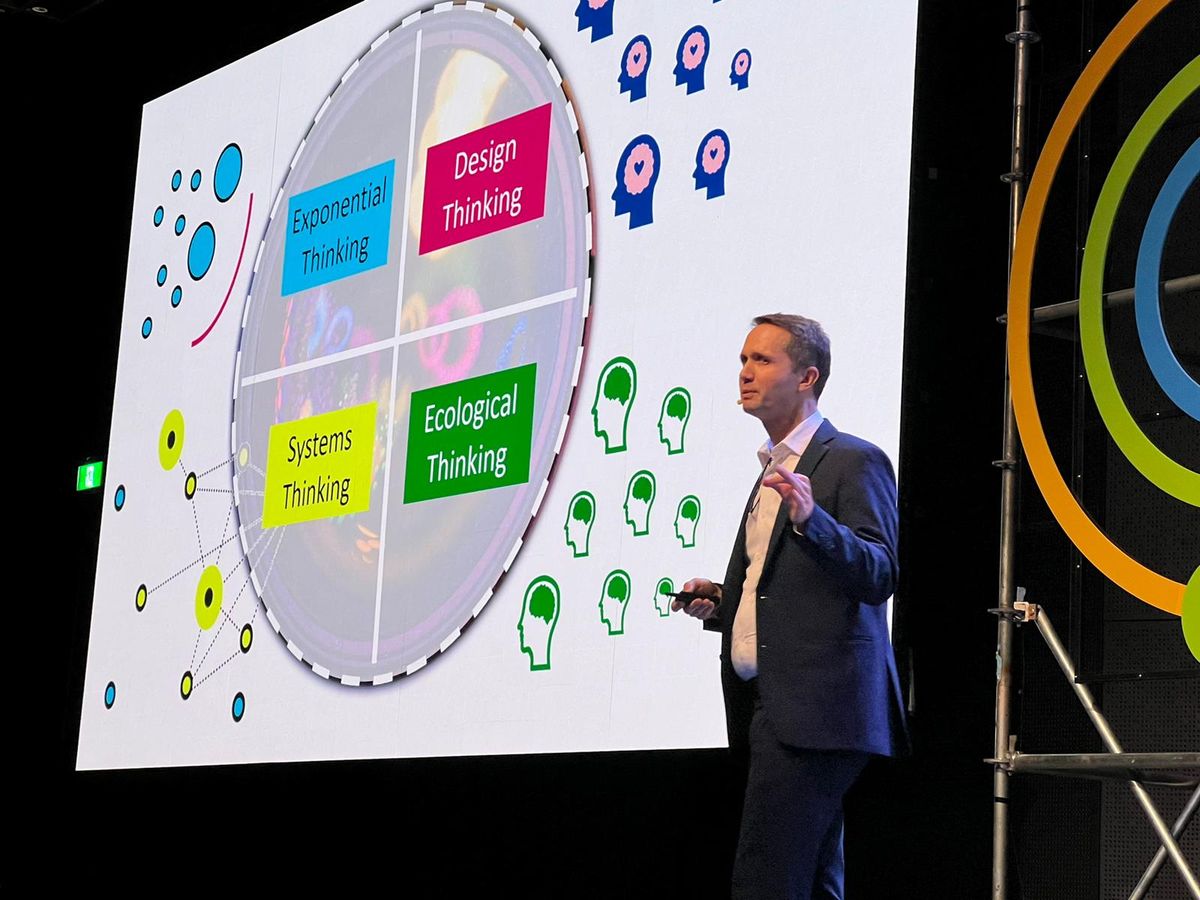
Michael Lewrick on stage explaining the lenses Exponential, Design, Systems and Ecological Thinking
Keynote · The lenses in practice

Inspire

Keynotes

For leadership events, conferences and boards. In English or German.

  • From Spotlight to FloodlightWhy human-centred design is no longer enough, and what comes next.
  • Bounce ForwardHow organisations become exponentializing, not just resilient.
  • Four Futures We Are Designing Right NowFutures thinking for leaders in the age of AI.
  • Learning from NatureBiomimicry, circularity and regenerative business models.
  • Exponential, with IntentAI and exponential technologies with an ethics compass.

Apply

Workshops

Hands-on with the book’s tools, on your own challenge.

  • Leadership Futures SessionScenarios, a preferable future and backcasting for the executive team.
  • Lens LabOne lens, its key tools and a concrete result for your project.
  • Resilience Blueprint SprintAll five lenses on one challenge, ending with your own Resilience Blueprint.
  • Win-Win-Win Ecosystem WorkshopPartners, value flows and leverage points for regenerative business ecosystems.

Build

Capability programmes

Build the skills to apply the lenses without outside help.

  • End-to-end programmeKick-off, five lens modules and a capstone on your strategic challenge.
  • Deep divesFutures Thinking, Exponential Thinking or any other lens in depth.
  • Train the facilitatorInternal facilitators who carry the methods into teams.
  • Leadership journeysModules spread over several months, combined with real projects.

Programme builder

Design your capability programme.

Choose end to end across all five lenses, or select the deep dives your organisation needs most.

Your programme

    V

    What leaders and researchers say.

    Voices on the book from science, sustainability and innovation.

    This insightful book elevates design methodologies into a systemic framework, providing leaders with the practical tools needed to integrate planetary boundaries, geopolitical risk, and technological advances into modern decision-making.
    Jennifer GardnerDirector, Stanford Doerr School of Sustainability
    An essential guide for leaders shaping the future, where scaling AI is not just a technical act, but a moral and systemic evolution in human wisdom and empathy.
    Deepti PahwaDistinguished Scholar Stanford GSB, MIT Media Lab: AI Ventures
    This unique book brings Design Thinking back to its original purpose: solving the world’s wicked problems, charting a course for a new era of designing exclusively for humanity.
    Fraunhofer IAOFraunhofer Institute for Industrial Engineering
    This bold and essential blueprint calls on leaders to move beyond human-centered design, providing the transformative framework needed to address today’s wicked problems through systemic, regenerative, and life-centered action.
    Chip FletcherDean, School of Ocean and Earth Science and Technology, University of Hawaiʻi at Mānoa
    Human-Centered Design was once the prevailing model; today it has expanded and Lewrick provides the clear, powerful frameworks needed to put these principles into practice and create a sustainable 3-wins model.
    Don NormanAuthor of Design for a Better World
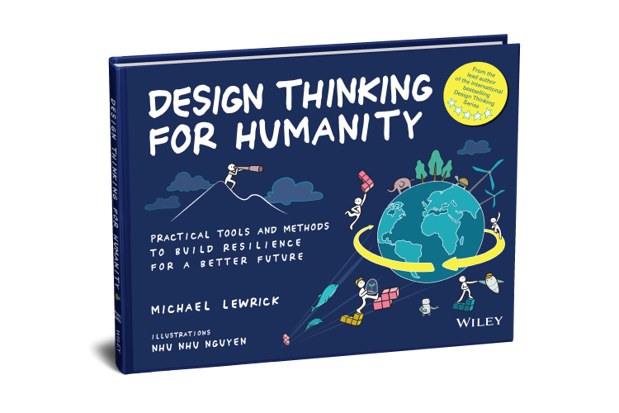
    Book cover: Design Thinking for Humanity by Michael Lewrick, illustrations by Nhu Nhu Nguyen, Wiley

    The book

    Design Thinking for Humanity

    Practical tools and methods to build resilience for a better future

    From the author of the international bestseller The Design Thinking Playbook. With a preface in dialogue with Jeanne Liedtka, the full toolbox for all five lenses, the Living Soil case study and the Resilience Blueprint. Illustrated by Nhu Nhu Nguyen.

    Publisher Wiley, 2026ISBN 978-1-394-36639-2

    Contact

    The tools are in your hands. What will you build?

    Keynote, workshop or capability programme: in a first conversation we find the format and the lenses that fit your organisation and your challenge.

    info@lewrick.chAll keynotes